
LEGO Train tracks
1980
In 1980, LEGO train tracks underwent a major redesign, changing from blue to a more realistic light grey rail color with dark grey ties. These new tracks came in two variants: a basic 4.5V version for battery/push-along trains and a 12V version with added metal conductor rails for powered, remote-controlled operation.
Types of 1980 LEGO Train Tracks
The track system introduced in 1980 (the "Grey Era") was designed to be modular and highly functional, a key feature of the popular 12V system. The basic geometry remained compatible with previous generations, but the components were updated for better stability with a new "snap-fit" design.
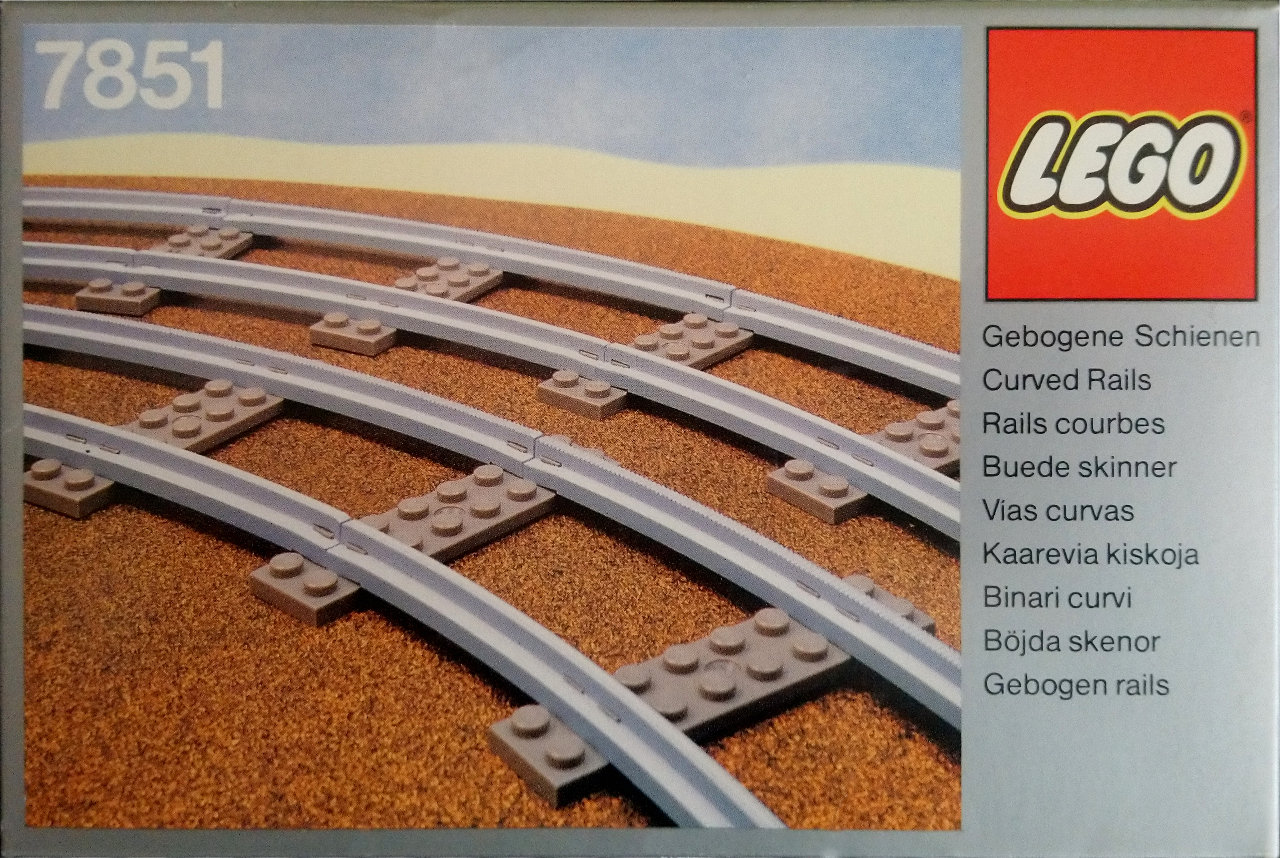
4.5V Tracks (Non-Electric): These tracks used plastic light grey rails snapped onto dark grey 2x8 plates serving as ties (sleepers). They were designed for push-along trains or those powered by a 4.5V battery box located within the train itself.
Available forms: Straight tracks (Item No. 7854), curved tracks (Item No. 7851), manual points (switches), and crossings were available.
12V Tracks (Electric): These were identical to the 4.5V tracks but included two additional metal conductor rails that ran down the center of the track. These center rails provided 12V DC power from a transformer, allowing for track-powered, remotely controlled trains and accessories like lights and signals.
Available forms: Electric straight tracks (Item No. 7855), electric curved tracks (Item No. 7856), remote-controlled points (switches), and electric crossings were available.
Key Design Changes
Color Change: The shift from the "Blue Era" tracks (blue rails and white ties) to the "Grey Era" system made the layouts look more realistic.
Sturdier Connections: The dark grey ties were a new, specialized part with clips to securely attach to the rail pieces, improving the overall stability of the track layout.
System Integration: The 12V system allowed for extensive trackside accessories, all controlled from a central panel, making the 1980s era highly customizable and popular among model rail enthusiasts.